By — Chonsview Media
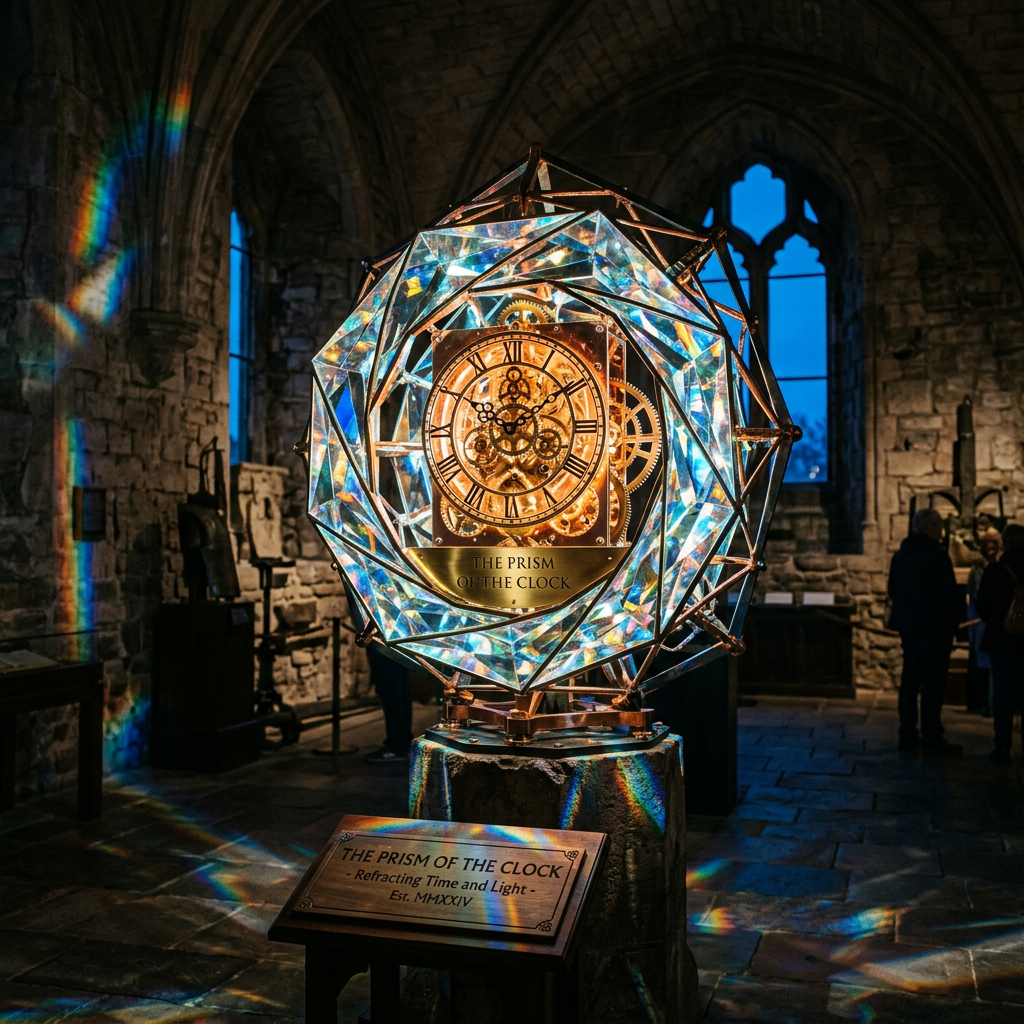
I. The Forgotten History of the Prism Clock: Horology’s Optical Masterpiece
Long before “mystery clocks” and transparent timepieces became luxury icons, Cartier quietly introduced one of the most ingenious horological inventions of the 20th century: the prism clock. Created in the 1930s by master clockmaker Gaston Cusin, this device blended mechanical precision with optical illusion in a way no other clock had before.
At first glance, the prism clock appears simple—almost minimalist. But its genius lies in what you cannot see.
The Hidden Dial
Unlike traditional clocks, the prism clock hides its dial and movement inside its base. There is no visible face, no exposed mechanism, no obvious source of time. Instead, the clock uses a system inspired by a submarine periscope: a precisely angled prism and mirror assembly that reflects the dial upward and forward.
The Optical Illusion
From the front, the viewer sees a crisp, elegant Cartier-style dial floating in space.
From the back, the clock appears empty—transparent—almost supernatural.
This duality is intentional. The prism clock was designed to challenge perception, to make time appear only when viewed from the correct angle. It is a mechanical metaphor for perspective itself.
Why It Was Revolutionary
• It fused optics and mechanics in a way never seen before.
• It created a controlled illusion using light, not transparency.
• It demonstrated that time could be hidden, revealed, or transformed through design.
• It became a symbol of Cartier’s ability to merge engineering with artistry.
The prism clock is not just a timepiece—it is a philosophical object disguised as a luxury artifact.
II. The Mechanical Genius Behind the Illusion
To appreciate the metaphor, you must first understand the mechanism.
1. The Periscope Principle
Inside the base sits the actual clock movement. Above it, a prism redirects light from the dial upward. A secondary mirror then angles that light toward the viewer’s eyes. This creates the illusion of a floating dial.
2. The Angle of Truth
The dial is visible only from the front because the prism is engineered to reflect light in a narrow, controlled path. Move behind the clock, and the reflection disappears. Time vanishes.
3. The Hidden Source
The viewer sees the result—the dial—but not the cause.
This separation between source and appearance is the heart of the prism clock’s magic.

III. The Metaphor: Time as a Prism
Once you understand the mechanics, the metaphor becomes powerful.
A prism takes a single beam of light and splits it into a spectrum.
The prism clock takes a single moment and reveals its hidden layers.
1. Time Changes With Perspective
Just as light refracts differently depending on angle, time feels different depending on emotion, memory, and awareness.
• Joy makes time feel fast.
• Pain makes time feel slow.
• Reflection makes time feel deep.
• Growth makes time feel meaningful.
The prism of the clock reminds us that time is not absolute—it is experiential.
2. Moments Contain Spectrums
A single event can split into:
• regret
• wisdom
• nostalgia
• clarity
• transformation
The prism clock shows that every moment carries more colors than we first see.
3. The Present Is a Lens
Where you stand today determines how you interpret yesterday and imagine tomorrow.
The prism of the clock teaches that perspective shapes reality.
4. Time Reveals Hidden Truths
Just as a prism reveals colors inside white light, time reveals meaning inside experience.
What was once confusing becomes clear.
What was once painful becomes instructive.
What was once chaotic becomes ordered.
Time is a prism, and consciousness is the viewer.

IV. The Spiritual Awakening Connection
This is where the metaphor deepens into spiritual territory—something that aligns beautifully with your Chonsview themes of awakening, symbolism, and inner clarity.
1. Awakening Is a Shift in Perspective
Spiritual awakening is not about gaining new information—it is about seeing the same life through a new lens.
The prism clock embodies this truth: the dial was always there, but only visible when viewed correctly.
Awakening is the moment you finally stand in the right place.
2. The Hidden Dial Represents Inner Truth
Just as the clock hides its dial, your inner truth is often concealed beneath layers of ego, fear, and distraction.
Awakening is the process of aligning your inner prism so that truth becomes visible.
3. The Spectrum Represents Expanded Awareness
When consciousness expands, life stops being black-and-white.
You begin to see:
• nuance
• symbolism
• interconnectedness
• synchronicity
• purpose
The prism of the clock becomes a metaphor for the prism of the soul.
4. Time Itself Becomes Sacred
In awakening, time is no longer a measurement—it becomes a teacher.
Every moment refracts into lessons, insights, and revelations.
The prism clock reminds us that time is not passing—it is unfolding.
V. Conclusion: The Clock, The Prism, The Awakening
The prism clock is more than a historical curiosity.
It is a symbol of how reality works.
• Mechanically, it hides the source and reveals the reflection.
• Metaphorically, it shows how time changes with perspective.
• Spiritually, it mirrors the awakening process—truth revealed only when consciousness aligns with the right angle.
In the end, the prism of the clock teaches a profound lesson:
Time is a beam of light, and your awareness is the prism.
Shift your perspective, and your entire life refracts into meaning.
This is the genius of the clock.
This is the metaphor of time.
This is the essence of awakening.
Thank you for visiting Chonview today. As you finish this read, I invite you to stay connected with Chonsview across all major social platforms and on my website, where I continue sharing stories, insights, and creative work that matter. If you’d like to support the journey, you can do so in many meaningful ways—whether by subscribing, donating, buying me a coffee, or exploring my book Ethiopia: A Timeless Tapestry, now available on Amazon. Every gesture of support helps fuel the work behind Chonsview. And just so you know, if you choose to shop through any of my Amazon affiliate links, I may earn a small commission at no extra cost to you. Your support truly makes a difference, and I appreciate you more than you know.
Make a one-time donation
Make a monthly donation
Make a yearly donation
Choose an amount
Or enter a custom amount
Your contribution is appreciated.
Your contribution is appreciated.
Your contribution is appreciated.
Leave a Reply