A historic and spiritual journey into Ethiopia’s most unreachable sanctuary

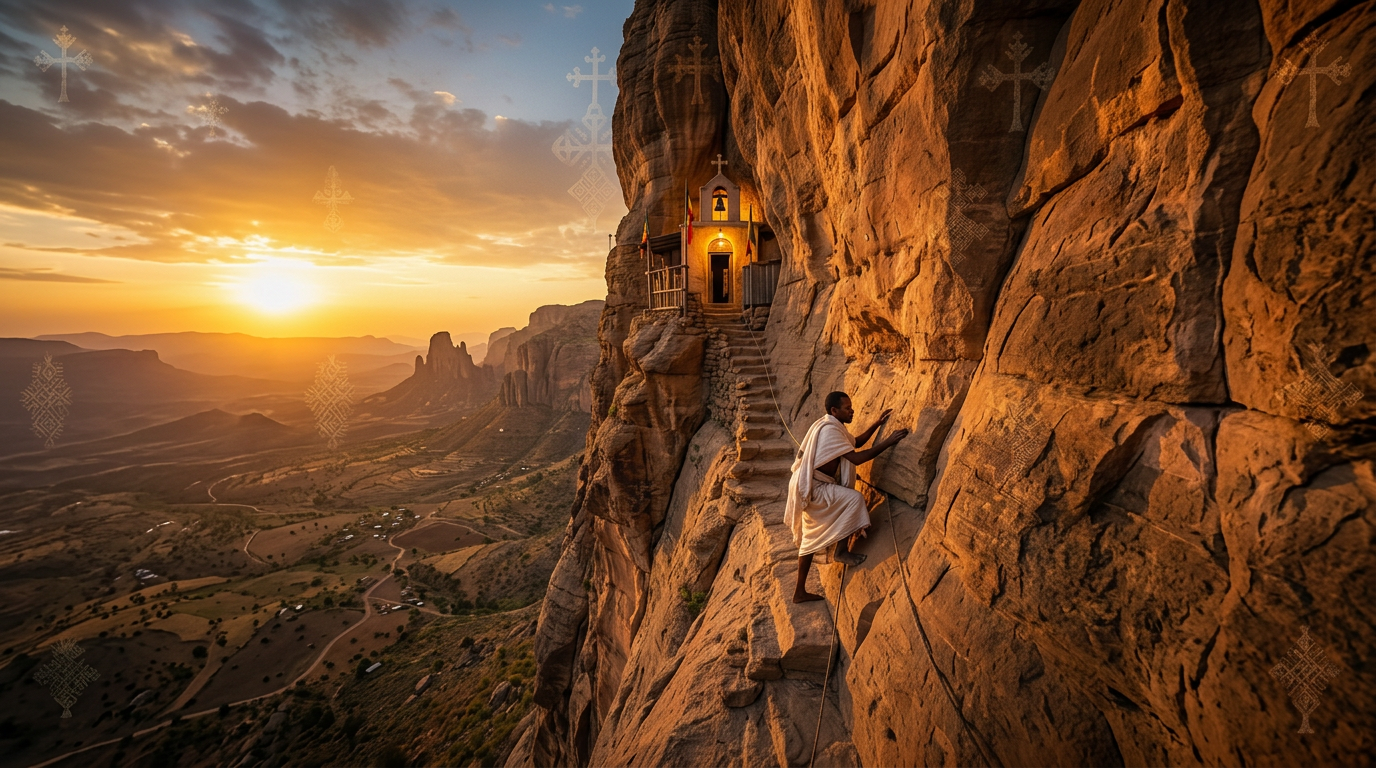
High in the sandstone cliffs of northern Ethiopia, carved into a sheer vertical rock face, lies a church that feels closer to heaven than earth. To reach it, you must climb barefoot along narrow ledges, press your body against ancient stone, and trust the same path monks have walked for over 1,500 years. There are no ropes. No railings. Only faith.
This is Abuna Yemata Guh — a church suspended between worlds.
A place where history, devotion, and geology merge into something almost supernatural.
This blog explores the origins, architecture, spiritual significance, and mystical experiences surrounding this sacred site — and why many believe it is one of the most powerful spiritual portals in Ethiopia.

1. The Origins: A Church Carved by Saints and Sky
Abuna Yemata Guh is named after Abuna Yemata, one of the Nine Saints who traveled from the Eastern Roman Empire to Ethiopia in the 5th–6th century. These saints helped establish monastic traditions and shaped the spiritual identity of the Ethiopian Orthodox Tewahedo Church.
Historical Foundations
• Built around the 5th century
• Entirely carved into a cliff in the Gheralta Mountains of Tigray
• Accessible only by a vertical climb of roughly 250 meters
• Frescoes dating back over 1,000 years, untouched by modern restoration
The church’s isolation was intentional. It was designed as a sanctuary protected from invaders, a place where monks could pray without interruption, and a symbol of devotion requiring physical and spiritual courage.
—
2. The Ascent: A Pilgrimage of Body and Spirit
Reaching Abuna Yemata Guh is not a casual hike — it is a pilgrimage.
Visitors must:
• Remove their shoes
• Climb barefoot along narrow cliff edges
• Scale vertical rock faces with handholds carved by monks
• Traverse a ledge only 30 cm wide with a 600-meter drop below
For Ethiopian Orthodox believers, this climb is symbolic.
It represents:
• Leaving the earthly world
• Confronting fear
• Trusting God
• Entering a higher spiritual realm
Many describe the ascent as a form of meditation — a moment where adrenaline, silence, and devotion merge.
3. Inside the Church: Art That Speaks Across Centuries
The interior of Abuna Yemata Guh is small, intimate, and breathtaking.
Frescoes & Iconography
The walls are covered with vibrant paintings of:
• The Nine Saints
• Archangels
• Apostles
• Biblical scenes
• Ethiopian Orthodox symbols
These frescoes are remarkably preserved due to the church’s altitude and isolation.
They are considered some of the oldest surviving Christian artworks in Africa.
Atmosphere
Inside, the air is cool and still.
The silence is profound.
The only light comes from a small opening carved into the cliff, illuminating the ancient paintings like a natural spotlight.
Many visitors describe a sensation of timelessness — as if the church exists outside the boundaries of history.
—
4. Spiritual Significance: A Portal Between Earth and Heaven
Abuna Yemata Guh is more than a historic site. It is a living spiritual portal.
Ethiopian Orthodox Perspective
The church is believed to be:
• A place where prayers ascend directly to heaven
• A sanctuary protected by angels
• A site where the veil between physical and spiritual worlds is thin
• A location where saints still intercede for believers
Monks say the altitude symbolizes closeness to God.
The climb represents purification.
The church itself is a reminder that faith requires effort, courage, and surrender.
—
5. Mystical Experiences Reported by Visitors
Many pilgrims and travelers describe unusual experiences:
• A sense of overwhelming peace
• Heightened awareness
• Emotional release
• Dreams or visions after visiting
• A feeling of being “watched over” during the climb
Some claim the church has a unique energetic frequency, similar to other high-altitude sacred sites around the world.
This aligns with spiritual theories that altitude, isolation, and ancient prayer sites create powerful energetic fields.
—
6. The Bridge Between History and Spirituality
Abuna Yemata Guh stands at the intersection of:
• Geology (a church carved into living rock)
• History (one of the earliest Christian sanctuaries in Africa)
• Spirituality (a site of devotion for over 1,500 years)
• Mysticism (a place where many feel the presence of something beyond human understanding)
It is a reminder that sacred spaces are not built only with stone — they are built with intention, sacrifice, and centuries of prayer.
—
7. Conclusion: Why Abuna Yemata Guh Matters Today
In a world of noise, speed, and distraction, Abuna Yemata Guh stands as a testament to devotion that defies gravity — literally.
It challenges us to ask:
• What does it mean to seek God?
• What does it mean to face fear?
• What does it mean to climb toward something higher?
Abuna Yemata Guh is not just a church.
It is a journey — one that transforms everyone who attempts it.
Make a one-time donation
Make a monthly donation
Make a yearly donation
Choose an amount
Or enter a custom amount
Your contribution is appreciated.
Your contribution is appreciated.
Your contribution is appreciated.
SEO Keywords
• Abuna Yemata Guh
• Ethiopian Orthodox history
• ancient churches of Ethiopia
• Gheralta Mountains
• Nine Saints Ethiopia
• spiritual sites in Africa
• cliff churches Ethiopia
• Ethiopian Christianity
• sacred places in Ethiopia
• historic Ethiopian architecture
Leave a Reply