
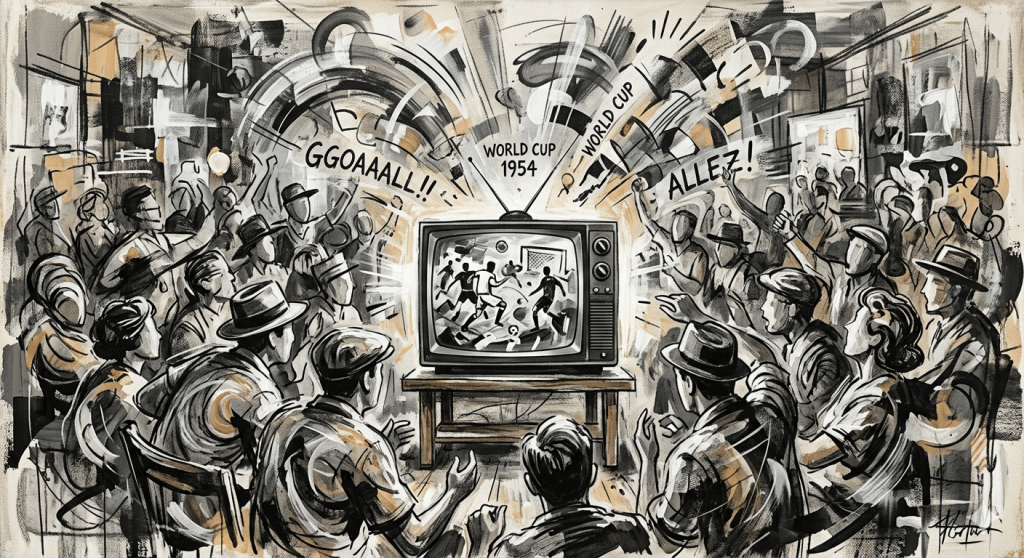
For billions of people around the globe, the ritual is identical: every four years, we gather around screens in living rooms, bars, and public squares to watch the drama of the FIFA World Cup unfold in real-time. Today, sports broadcasting is a multi-billion dollar juggernaut. However, this inseparable marriage between football and the small screen had a definitive, chaotic, and experimental beginning: the 1954 FIFA World Cup in Switzerland.
While the beautiful game had previously been confined to stadium walls and crackling radio waves (Lee, n.d.), the 1954 tournament fundamentally reshaped how the world consumed sports. It forced the birth of pan-European broadcast networks, altered stadium dynamics, and proved that a sporting event could become a global cultural phenomenon (Vonnard, 2018).
1. The Architectural Catalyst: Enter Eurovision
The story of the first televised World Cup is as much a story of engineering and geopolitics as it is about football. In 1954, television was still a luxury, and national broadcasters largely operated in isolated silos.
The turning point came when Marcel Bezençon, the first director of the Eurovision Programme Commission, recognized an opportunity. He realized that if television networks wanted to expand their reach and justify their growing infrastructure, they needed a compelling, unmissable event. Bezençon later noted that the official launch of the pan-European Eurovision network in June 1954 was explicitly timed to coincide with the World Cup (Vonnard, 2018).
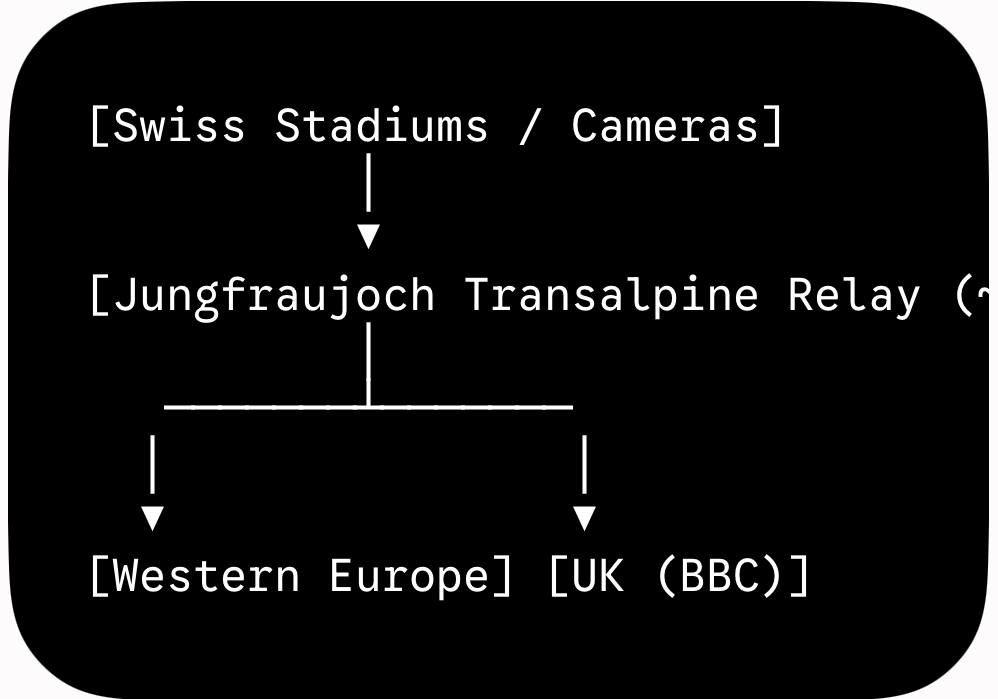
The network brought together public service broadcasters from Across Western Europe under the umbrella of the European Broadcasting Union (EBU) (Bela Nunes & Valério, 2020). To pull off the broadcast, a massive physical infrastructure had to be hastily constructed across Switzerland:
The Transalpine Relay: Technicians set up a web of high-frequency radio-relay links across the Swiss mountains.
The Jungfraujoch Station: A crucial relay station was perched nearly 12,000 feet up on the Jungfraujoch mountain to send the television signals over the Alps to neighboring countries like France, West Germany, Italy, the Netherlands, and the UK.
2. The Living Room Experience of 1954
What did a spectator actually see when they tuned into the 1954 matches? By 2026 standards, it was experimental archaeology; by 1954 standards, it was magic.
Limitations and Scale
Television screens were tiny, curved, and exclusively black-and-white. Broadcasters did not yet possess global satellite capabilities or color formatting—technologies that wouldn’t arrive until the 1970 World Cup in Mexico (Lee, n.d.). Furthermore, replay technology did not exist; if a viewer blinked during a goal, they had to wait for the evening highlight reel or the next day’s newspaper (Lee, n.d.).

Despite these limitations, the broadcast was an undeniable success. A total of nine matches were broadcast live. Over 4 million viewers across Europe watched the games on roughly 3 million television sets, with millions more crowding into appliance store windows, cafes, and community spaces to catch glimpses of the action.
3. How Television Reshaped the Game
The 1954 broadcast quickly revealed that television transforms professional football in how it is organized, played, and perceived (Aji et al., 2018). This first experiment triggered several immediate changes:
The Birth of Broadcast Rights
Prior to 1954, FIFA and local football clubs relied almost exclusively on ticket sales for revenue. The realization that millions were watching from home fundamentally altered their business model. Recognizing the immense value of their product, FIFA began selling broadcasting rights for World Cup matches (Lee, n.d.).
Initially, football executives worried that putting games on television would cannibalize stadium attendance and bankrupt clubs (Vonnard, 2018). To offset this perceived threat, early strategies focused on charging premium fees to networks, which FIFA then used to subsidize youth associations, referee training, and travel expenses for smaller federations (Vonnard, 2018).
The “Hyperreality” of the Screen
Sociological research notes that television introduced a completely new way of experiencing sports. Philosophers and media scholars point out that television prioritizes a curated visual landscape over the raw, sensory experience of the stadium (Aji et al., 2018). In 1954, viewers at home saw close-up framings and tactical angles that fans in the stadium could not perceive, laying the groundwork for modern fandom where the broadcast representation begins to replace the on-pitch reality (Aji et al., 2018).
4. The Drama Captured On Screen: “The Miracle of Bern”
It was entirely fitting that the first televised World Cup featured arguably the most dramatic final in football history. On July 4, 1954, the dominant, seemingly invincible “Magical Magyars” of Hungary—led by Ferenc Puskás—faced West Germany in the final at the Wankdorf Stadium in Bern.
Hungary had already obliterated West Germany 8-3 in the group stage and had gone unbeaten for four years. When Hungary took a 2-0 lead within the first eight minutes, viewers across Europe assumed the rout was on. Instead, the television cameras captured a historic underdog comeback. West Germany equalized before halftime and scored the winning goal in the 84th minute to secure a shocking 3-2 victory.
The live broadcast of this match, known historically as “The Miracle of Bern,” had profound political and social implications. For a fractured, post-war West Germany, watching their team win on live television catalyzed a massive wave of collective pride and national identity, serving as a peaceful vehicle for a country trying to rebuild its image on the international stage (Schiller, 2014).
The Legacy of 1954
The 1954 World Cup proved to the world that sports and television were a perfect match. The tournament served as a giant commercial advertisement for television itself, driving a massive surge in TV set sales across Western Europe immediately following the event (Vonnard, 2018).
What started as a frantic attempt to beam black-and-white signals over the Swiss Alps laid the foundation for the interconnected, global sports culture we experience today. Every time we open a streaming app or watch a high-definition slow-motion replay, we are participating in a legacy that began in the mountains of Switzerland in the summer of 1954.
References
Aji, R., Hermawan, E., & Riyadi, M. (2018). Hyperreality in a football live on television. Proceedings of Social Sciences, Humanities and Economics Conference (SoSHEC 2017), 221-224. Atlantis Press. https://doi.org/10.2991/soshec-17.2018.35
Cited by: 1
Bela Nunes, A., & Valério, N. (2020). UEFA: A successful Pan-European organization during the Cold War. Athens Journal of Sports, 7(1), 55-76. https://doi.org/10.30958/ajspo.7-1-4
Cited by: 9
Lee, S. (n.d.). Importance-Performance analysis of Korea’s relay broadcast of the 2022 FIFA World Cup. DergiPark.
Cited by: 0
Schiller, K. (2014). Siegen für Deutschland? Patriotism, nationalism and the German national football team, 1954-2014. Historical Social Research, 364.
Cited by: 16
Vonnard, P. (2018). The World Cup and the media. InMedia. The French Journal of Media Studies, 7(1). https://doi.org/10.4000/inmedia.1532
Cited by: 3
As you finish this read, I invite you to stay connected with Chonsview across all major social platforms and on my website, where I continue sharing stories, insights, and creative work that matter. If you’d like to support the journey, you can do so in many meaningful ways—whether by subscribing, donating, buying me a coffee, or exploring my book Ethiopia: A Timeless Tapestry, now available on Amazon. Every gesture of support helps fuel the work behind Chonsview. And just so you know, if you choose to shop through any of my Amazon affiliate links, I may earn a small commission at no extra cost to you. Your support truly makes a difference, and I appreciate you more than you know.
Make a one-time donation
Make a monthly donation
Make a yearly donation
Choose an amount
Or enter a custom amount
Your contribution is appreciated.
Your contribution is appreciated.
Your contribution is appreciated.
 Chonsview Media